Sunday, February 7, 2010

Galvanization


The roadway crash barrier, is a metal product that normally its not considered atractive. But wisely manipulated this material can acquire unique characteristics.

Technical aspects

Before being galvanized, steel must be first cleaned by means of abrasive blasting and pickling. The steel can then be dipped into a bath of molten zinc. Elements should be constructed as symmetrically as possible, large differences in material thickness in a single object should be avoided an thin sheet steel should be supported with cross stays.

Applications

Galvanized steel, in the form of gratings, stairs, or structural components, may be properly used on locations exposed to corrosive environment or even places where maintenance is difficult.

Colour: Grey
Glossiness: Glossy,
satin, matt
Translucence (%)
: 0 – 20 – 40 – 60 – 80 – 100
Texture: Sharp, medium
, dull
Hardness:
hard, soft, depressible
Temperature: warm, medium,
cool
Odour: Strong, moderate, none
Acoustic opacity: good, moderate, poor

Insulating Glass


Insulating glass consists of three or two glass plates separated by two or one cavities of air hermetically sealed. The thermal insulation capacity of this type of glass, often the so called superwindows, is far superior from the conventional glass, of single glass plate. The decorative possibilities for this type of glass are also unlimited. The cavities can be filled with a variety of elements or objects.

Technical characteristics

The cavities insulating glass are filled with air or even gases such as krypton or argon (much better). Insulation can even be improved by an addition of low-emissivity coating on the inner side of the cavity. The coating consists on a very thin silver coloured foil, which diminishes the heat exchange between the warm inner pane and the colder outer pane, and so increasing thermal resistance. Another technique is to fill the cavity with vacuum, but for this effect it may be necessary extreme care cause the glass as tendency to break under the process because of the pressure.

Other heat-absorption techniques may be added to the glass. The glass cavities can increase their heat absorption by the insertion of adjustable aluminium louvres, glass or plastic tubing and a variety of metallic meshes. This additions, according to the taste may also acquire aesthetic qualities.

Application

Used exclusively as a thermal insulation for façade openings.

Colour: None
Glossiness: Glossy, satin, matt
Translucence (%): 0 – 20 – 40 – 60 – 80 – 100
Texture: Sharp, medium, dull
Hardness: hard, soft, despressible
Temperature: warm,
medium, cool
Odour: Strong, moderate,
none
Acoustic opacity: good, moderate,
poor


Basalt Lava


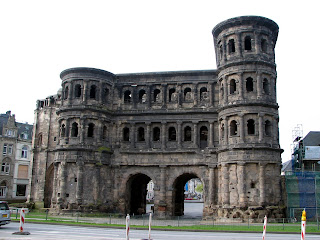
Chosen by the Romans to build Porta Nigra at Trier, the basalt with its dark almost black colour is a material that possesses particular features that distinguishes itself from any other material.

Technical characteristics

Basalt is an extrusive rock with a porous appearance. Remnants from the gas bubbles during the stone formation fill its surface with tiny cavities. Although this porosity, the rock's frost resistance is not affected, as well as the water doesn't penetrate deep on the rock.
A negative aspect may be the hardness of the rock, making it hard to harvest and not as flexible to work as building material as other rocks. However nowadays with the help of innovative techniques, the rock can be worked ina variety of ways. It can be polished, sacrificing the stone's true character. The colour is typically dark grey with blue, green and brown hues. There is also a red variant with the presence of free iron.

Applications

Basalt lava is amazing for cladding for façades do to its weather resistance. Besides from cladding for façades, basalt lava can also be used for steps and threshols due probably to its "tough" characteristic, and in addition its surface its never slippery when wet because of the cavities.

Colour: Grey, blue
Glossiness: Glossy,
satin, matt
Translucence (%): 0 – 20 – 40 – 60 – 80 – 100
Texture: Sharp,
medium, dull
Hardness: hard, soft, despressible
Temperature: warm,
medium, cool
Odour: Strong, moderate,
none
Acoustic opacity: good, moderate,
poor